
Intra-Party Consultation on Gender Equality and Social Inclusion (GESI) in Political Party FrameworksJamiat Ulema-e-Islam Pakistan (JUI-P) - Aurat Foundation
Aurat Foundation convened an Intra-Party Consultation with Jamiat Ulema-e-Islam Pakistan (JUI-P) on 27 August 2026 in Islamabad, under the EU-supported Pakistan Women Leaders project, a joint initiative of UNDP and UN Women. The session focused on Gender Equality and Social Inclusion (GESI) within political party frameworks, with particular reference to the JUI-P Party Constitution. The […]
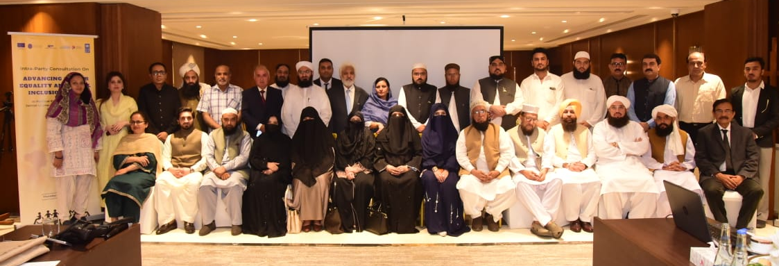
Aurat Foundation convened an intra-party consultation with Jamiat Ulema-e-Islam Pakistan in Islamabad on 27 August 2026. The meeting formed part of the EU-supported Pakistan Women Leaders project, implemented jointly with UNDP and UN Women, and focused on embedding gender equality and social inclusion in political-party frameworks.
The session reviewed the JUI-P party constitution and opened with prayers and condolences for the infants who had died at Pakistan Institute of Medical Sciences Hospital. Mumtaz Mughal introduced the objectives, centred on women’s meaningful political participation, gender equality and the inclusion of under-represented groups within party structures.
Aurat Foundation Executive Director Naeem Mirza called for an enabling environment in which women can exercise leadership, gain representation and participate effectively in decision-making. He encouraged an open discussion of institutional barriers and practical changes that political parties could make to their internal policies and procedures.
Isma Toseer outlined UNDP’s PLEDGE programme and its work on democratic institutions, legislative and electoral processes, digital governance and citizen empowerment. Her presentation linked social inclusion to stronger institutions and broader participation by citizens and stakeholders.
JUI-P representatives described the party’s existing structures. Naeema Kishwar Khan referred to the Women’s Forum and Women’s Wing as platforms for representation and leadership, while Shahida Begum discussed the constitutional framework and examples of women serving in political and parliamentary roles.
Abdul Jalil Jan explained the organisational chain from grassroots units to district, provincial and central bodies, as well as the responsibilities of the General Council, Consultative Council and Executive Council. He also described membership arrangements and election boards involved in nominating candidates for the Senate, assemblies and local government.
The structural review gave participants a basis for considering where women and marginalised communities could gain stronger access to membership, leadership and decision-making. It also identified party constitutions and internal governance rules as practical levers for moving beyond symbolic representation.
Parliamentary and constitutional specialist Ali Imran presented a GESI framework for party codes of conduct and best practice. The framework emphasised non-discrimination, equal opportunity, respectful political engagement and safe conditions for women and other groups that remain under-represented.
Members of national and provincial assemblies, party office-holders and senior Majlis-e-Shura representatives contributed questions and reflections. The exchange considered both the opportunities available within existing structures and the barriers that still limit inclusive participation.
Closing remarks stressed continued dialogue between political parties and civil society. Participants were encouraged to carry forward the recommendations, strengthen internal mechanisms and sustain work on gender-responsive, socially inclusive political institutions rather than treating the consultation as a one-off event.