
When a Migrant Worker Is Cheated: The Case of Shanti — HOME
Migrant workers who come to Singapore seeking a better livelihood can be vulnerable to recruitment scams, including false job offers, excessive recruitment fees, forged documents, and promises of employment that are never fulfilled. In principle, Singapore’s employment regulations and law-enforcemen
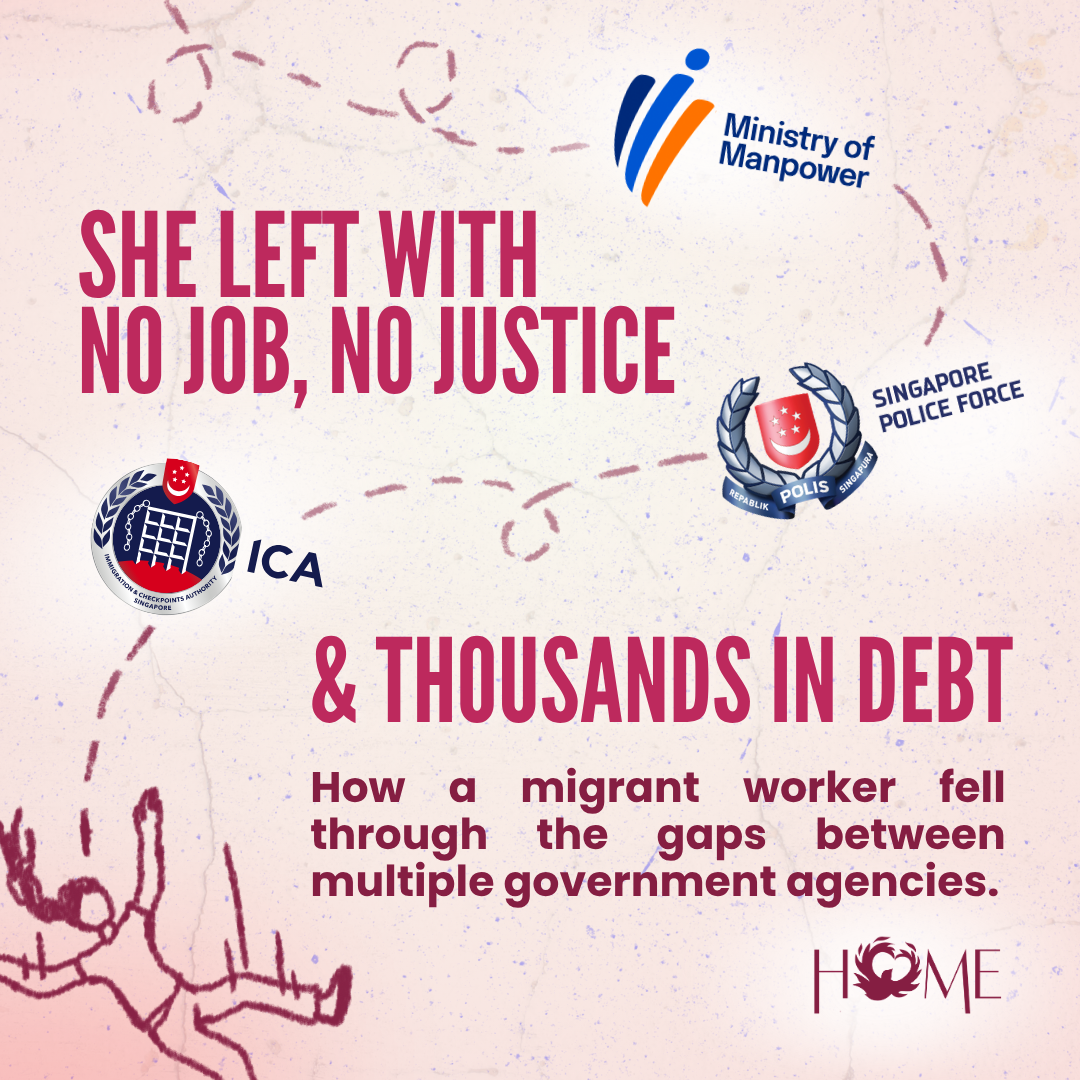
HOME used Shanti’s case to illustrate how migrant workers can fall between recruitment regulation, immigration administration and criminal enforcement. Recruitment fraud may involve false jobs, excessive fees, forged documents or employment that never materialises, but responsibility can become unclear when agents operate across borders.
In April 2026, while she was still in India, an agent using the name Sam offered Shanti a dishwasher position at a Sentosa hotel with a monthly basic salary of S$1,100. Her interview consisted only of two self-introduction videos, after which she received a screenshot suggesting that a work pass had already been approved.
She was instructed to transfer INR472,500—almost S$6,500—to Indian accounts and another S$1,500 to accounts in Singapore. Only after making the payments did she receive an In-Principle Approval stating a different occupation, household service worker, and a gross monthly salary of S$700 made up of S$400 basic pay and a S$300 allowance.
When Shanti challenged the discrepancy, she was reassured that she would still work as a dishwasher and receive accommodation. She was later sent a document presented as a security bond.
Shanti paid for her own flight and arrived in Singapore on 18 May. Nobody met her, she had to arrange accommodation with friends, and despite repeatedly asking the agent, she was never deployed to a job.
A second person using the name Kate contacted her. On 3 June, after being directed to a flat in Jurong West for an interview, Shanti learned that her In-Principle Approval had been cancelled on 30 May. She had believed throughout that work would soon begin and felt unable simply to leave because of her debt and responsibility for three children.
Kate later presented a short-term visit pass expiring on 17 June and instructed Shanti to travel to Malaysia. Shanti declined because she wanted lawful work in Singapore and needed to repay the recruitment costs. She approached HOME on 11 June.
The company named on the approval denied knowing that Shanti had arrived. It said an India-based agent had reported that she no longer wanted the job and that the approval should be cancelled. The company also said the security-bond document had been forged and indicated that other workers had faced similar circumstances.
The Ministry of Manpower told Shanti there was limited action it could take against overseas agents where no Singapore employment agency was involved. Although it was examining how the approval had been issued, it did not consider her continued presence necessary; her visit pass was not extended and she was directed to make a police report concerning payments to Singapore accounts.
Police treated the matter as a civil breach of agreement rather than criminal cheating because a genuine approval had once existed and the local transfers might have represented recruitment fees. Shanti was advised that she could pursue private civil proceedings.
With no work, no continuing immigration status and no agency taking overall responsibility for investigating the recruitment chain, Shanti left Singapore on 17 June. She had not recovered her payments, and the published account did not establish whether anyone was held accountable.
Questions raised by HOME
- Why could a worker reporting a recruitment scam not remain temporarily to seek lawful alternative employment?
- Why were the holders of Singapore bank accounts that received the transfers not investigated as part of the alleged deception?
- Why is there no coordinated cross-border response between governments as transnational recruitment scams become more common?
- Does the absence of a strong and clearly owned enforcement response reduce deterrence and allow similar schemes to continue?